An ac shade kit Santa Clara, CA homeowners can trust won't cut your power bill in half, no matter what the product photos imply. It will, in most cases, take some heat stress off your compressor and help your system run a little cooler through August afternoons. Here's what the actual research says, what it costs, and how to size and install one without hurting the airflow your AC depends on.
Does an AC Shade Kit Really Work in Santa Clara's Climate?
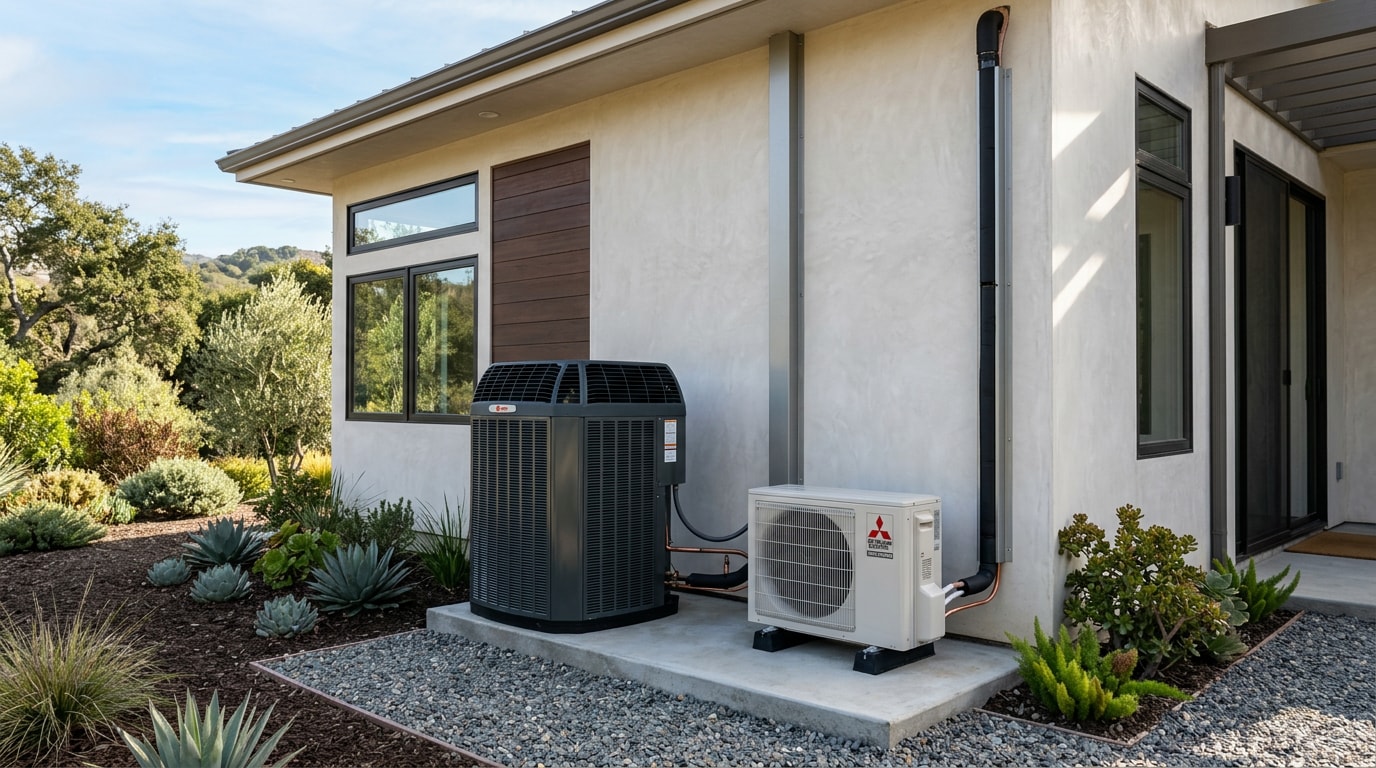
Santa Clara summers push condensers hard. Afternoon highs regularly sit in the mid-80s to low 90s, and a condenser mounted against a stucco wall on the west side of a house absorbs radiant heat long after the sun moves past.
Shading that unit lowers the air temperature right around the cabinet, which can ease the load on the compressor. The size of that benefit, though, depends heavily on which study you're reading and what kind of shading is being tested.
During AC tune-ups across Santa Clara, Sunnyvale, and Cupertino, our technicians routinely find condensers on unshaded west- or south-facing walls running noticeably hotter to the touch by late afternoon than units with even partial natural shade on the same block. That field pattern lines up with the research, but the efficiency numbers tied to it are smaller than most marketing pages let on.
Here's how the frequently cited sources actually compare:
| Source | Reported Efficiency Gain | What It Actually Measured |
|---|---|---|
| ACEEE field study (Parker et al.) | ~0.1% average, up to 1% best case | Real shading added to existing condensers, not models |
| Florida Solar Energy Center research | Roughly 1-3% | Drop in condenser inlet air temperature |
| Kuwait Institute for Scientific Research (2010) | Up to about 1% | Theoretical COP modeling in extreme heat |
| DOE / EPA tree-shading guidance | Up to 10% | Whole-yard tree shading that cools the house and ground, not just the condenser box |
The gap between "1%" and "10%" isn't a contradiction once you separate the two claims. A field study on condenser shading presented through ACEEE found average measured savings so small the researchers couldn't rule out zero effect, and flagged that poorly placed shade can actually trap hot exhaust air and hurt performance. The bigger double-digit numbers almost always describe shading an entire yard with mature trees, which cools the house itself and reduces the total cooling load, not just the metal box outside.
Where most sources agree: shade protects the compressor and cabinet from years of direct UV and heat exposure, which matters for longevity even when the efficiency bump is small. If your unit already sits in partial shade from a fence or the house itself, a shade kit adds less value. If it bakes in full afternoon sun against a bare wall, a properly installed kit is more likely to make a real difference. Our air conditioning contractor team can take a look at your specific setup if you're not sure which camp your system falls into.
What the Research Gets Wrong About Shading a Condenser
The main reason shading a condenser doesn't move the needle much is airflow volume. A residential condenser pulls a very large amount of ambient air through its coil every hour, far more than a small shaded zone can meaningfully cool before it's drawn in.
A newer modeling study out of the Kuwait Institute reached a similar conclusion under extreme-heat conditions. The peer-reviewed analysis published in Solar Energy found that the actual efficiency improvement from shading alone is not expected to exceed roughly 1%, and that the gain shrinks further as ambient temperatures climb, which is exactly when homeowners want the most help.
That doesn't mean shading is pointless. It means the honest pitch is "modest efficiency gain, meaningful protection from heat and UV wear," not "cut your bill in half."
Shade Kit Materials: Which Type Fits a Santa Clara Backyard
Every shade product on the market trades off airflow, durability, and looks differently.
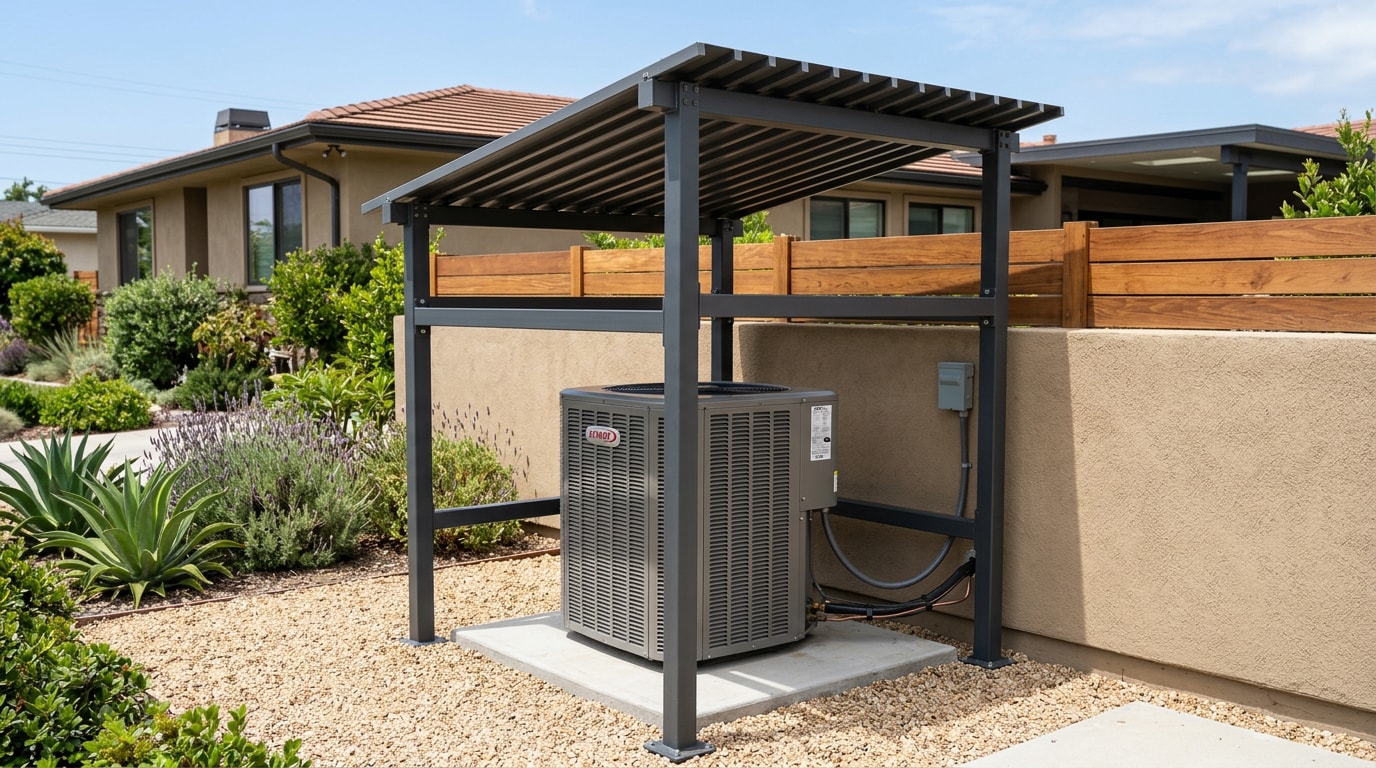
- Steel awnings offer the most rigid, long-term coverage but cost the most and need careful clearance planning around existing landscaping or fencing.
- UV-resistant fabric sails are a popular middle ground. Most quality outdoor fabrics are rated to block a large share of solar UV while still letting air pass through the weave.
- Mesh screens trade some shade coverage for maximum airflow, which makes them a safer default if you're unsure about clearance.
- Aluminum slat covers sit between the two, offering more solid coverage than mesh with less bulk than a steel structure.
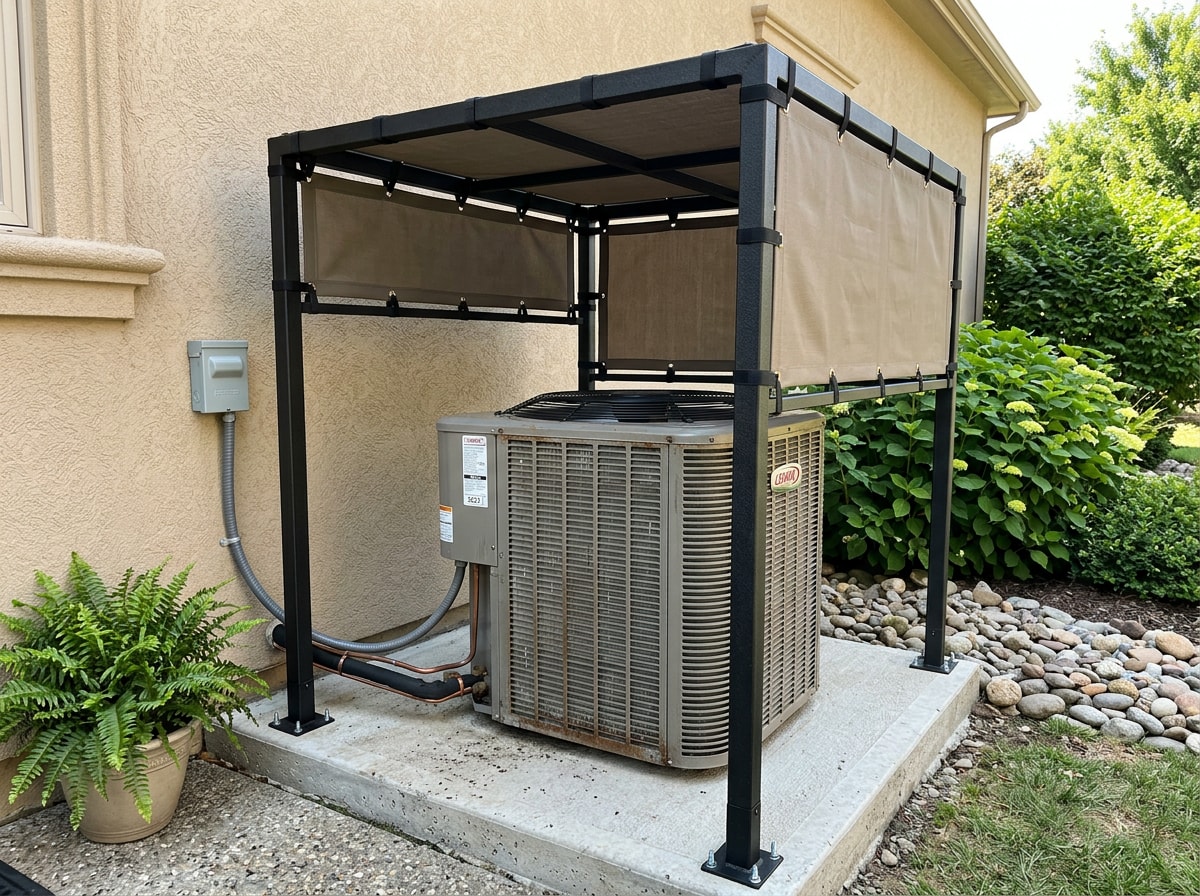
Airflow is the deciding factor across every option. Whatever you choose, an open-sided, open-top design beats a fully enclosed box every time, because a condenser that can't breathe loses far more efficiency than shade ever gains back.
Sizing and Clearance Rules That Actually Matter
Get the clearance wrong and a shade kit will cost you more in efficiency than it saves. ENERGY STAR's home HVAC maintenance guidance emphasizes keeping indoor and outdoor units clean and clear of debris as a baseline for efficient operation, and that same open-air principle governs shade kit sizing.
A common, manufacturer-backed rule of thumb calls for at least two feet of clear space around the unit and roughly eight feet of clearance above it to let air move freely into the sides and out the top.
Practical sizing guidelines for a shade kit:
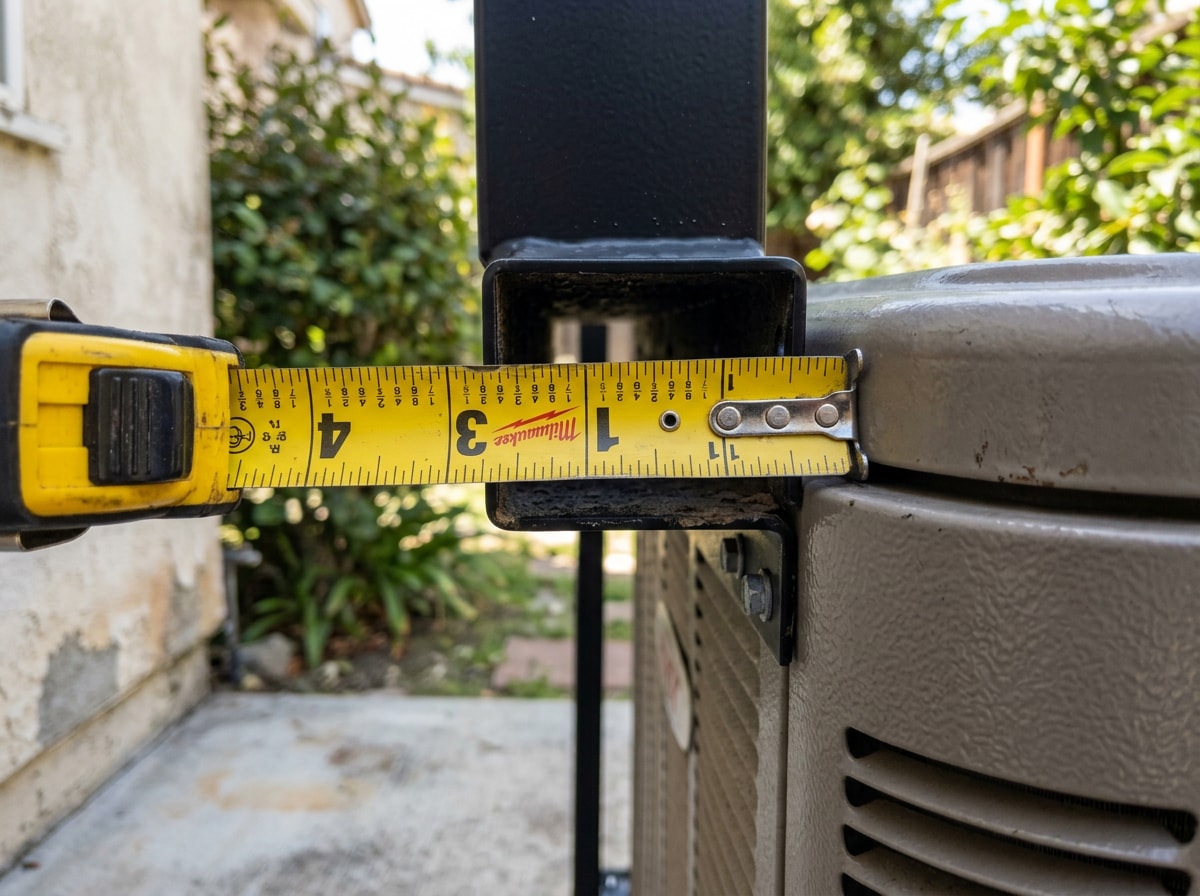
- Leave at least 24 inches of open space on every side between the shade frame and the condenser cabinet.
- Keep at least 4 to 5 feet of vertical clearance above the unit so hot exhaust air can rise and disperse instead of recirculating back into the intake.
- Size the canopy footprint wider than the unit itself, not matched to it, so hot air has somewhere to go before it pools.
- Check your specific model's installation manual, since some manufacturers call for more clearance than the general rule.
Skipping the clearance math is the single most common reason a shade kit backfires.
How to Install an AC Shade Kit Safely
Placement comes before assembly. Identify which side of the unit takes the hardest direct sun, usually south- or west-facing in Santa Clara, and plan the shade to block that angle rather than just covering the top.
Most modular kits ship as a simple parts list: frame poles, corner connectors, support ribs, and a fabric or mesh canopy. Assembly generally follows this sequence:
- Connect the frame poles into a square using the corner connectors.
- Lay the canopy fabric flat and align its sleeves with the assembled frame.
- Slide the remaining poles through the canopy pockets and into the open corner slots to lock the structure together.
- Position the finished frame over the unit so the open center lines up directly with the exhaust fan, maximizing coil coverage without blocking the escape path for hot air.
Nothing in this process should attach to the condenser housing itself. If it requires drilling into the unit or screwing a bracket to the cabinet, it's the wrong kit.
If you'd rather have a professional confirm placement and clearance before you buy anything, our AC maintenance team can check your setup during a routine visit, and our AC installation specialists can factor shade and sun exposure into placement if you're installing a new system. Get a free estimate and we'll walk the yard with you before anything goes in the ground.
How Much Does an AC Shade Kit Cost in Santa Clara?
| Option | Typical Cost Range | Notes |
|---|---|---|
| Mesh or fabric DIY kit | $80-$250 | Easiest to self-install; lowest wind/snow load rating |
| Aluminum slat cover | $200-$450 | More rigid, moderate DIY difficulty |
| Steel awning structure | $400-$1,200+ | Best longevity; usually needs a short pro install |
| Professional placement check or install | $100-$300 labor | Confirms clearance and anchoring on uneven yards |
Prices vary by brand, unit size, and whether you're anchoring into concrete, gravel, or soil. Given the modest efficiency upside documented above, most homeowners get the best return by choosing a mid-range kit and prioritizing correct clearance over premium materials.
If your home is already in full sun with an aging or undersized system, a smart home upgrade like app-controlled cooling often delivers more noticeable comfort and savings than condenser shading alone. (See our guide to auto air conditioning in Sunnyvale for what that upgrade involves.)
For homeowners anywhere from Santa Clara to the surrounding South Bay, our Santa Clara service area page has details on local scheduling and response times. You can also start from our homepage to see the full range of cooling services we offer.
FAQ
Will an AC shade kit work with my AC unit?
Most shade kits are designed for top-discharge central condensers, which cover the majority of residential systems. Measure your unit's footprint and confirm the kit's clearance zone matches before buying, since fit depends more on spacing than brand.
Will a tarp or blanket over the condenser help?
No. Draping a tarp or blanket over a running condenser traps heat and blocks the airflow the unit depends on, which can strain the compressor instead of protecting it. A purpose-built kit has open sides and vertical clearance specifically to avoid that problem.
Will an AC shade kit damage my unit or void the warranty?
A correctly installed kit shouldn't attach to the condenser housing at all, no drilling or screws into the cabinet. Because nothing modifies the equipment, a properly spaced kit generally doesn't affect a manufacturer's warranty, but check your specific unit's warranty terms to be sure.
How much does an AC shade kit cost installed in Santa Clara?
Expect $80-$250 for a basic DIY mesh or fabric kit, $200-$450 for aluminum, and $400-$1,200+ for a steel structure. Add $100-$300 if you want a technician to confirm clearance and handle anchoring.
Should I install it myself or hire a pro?
Mesh and fabric kits are reasonable DIY projects for most homeowners. Steel structures, uneven yards, or units mounted on decks or tight side yards are worth a quick professional clearance check first, since a misjudged install can trap heat instead of blocking it.
---
This guide was reviewed by the licensed HVAC technicians at Made Simple Heating and Air, who service central air conditioning systems throughout Santa Clara, Sunnyvale, and the surrounding South Bay. Questions about your specific setup? Contact us and we'll help you figure out what's worth doing before you spend money on a shade kit.